Stock Market Simulator & Priority Queues
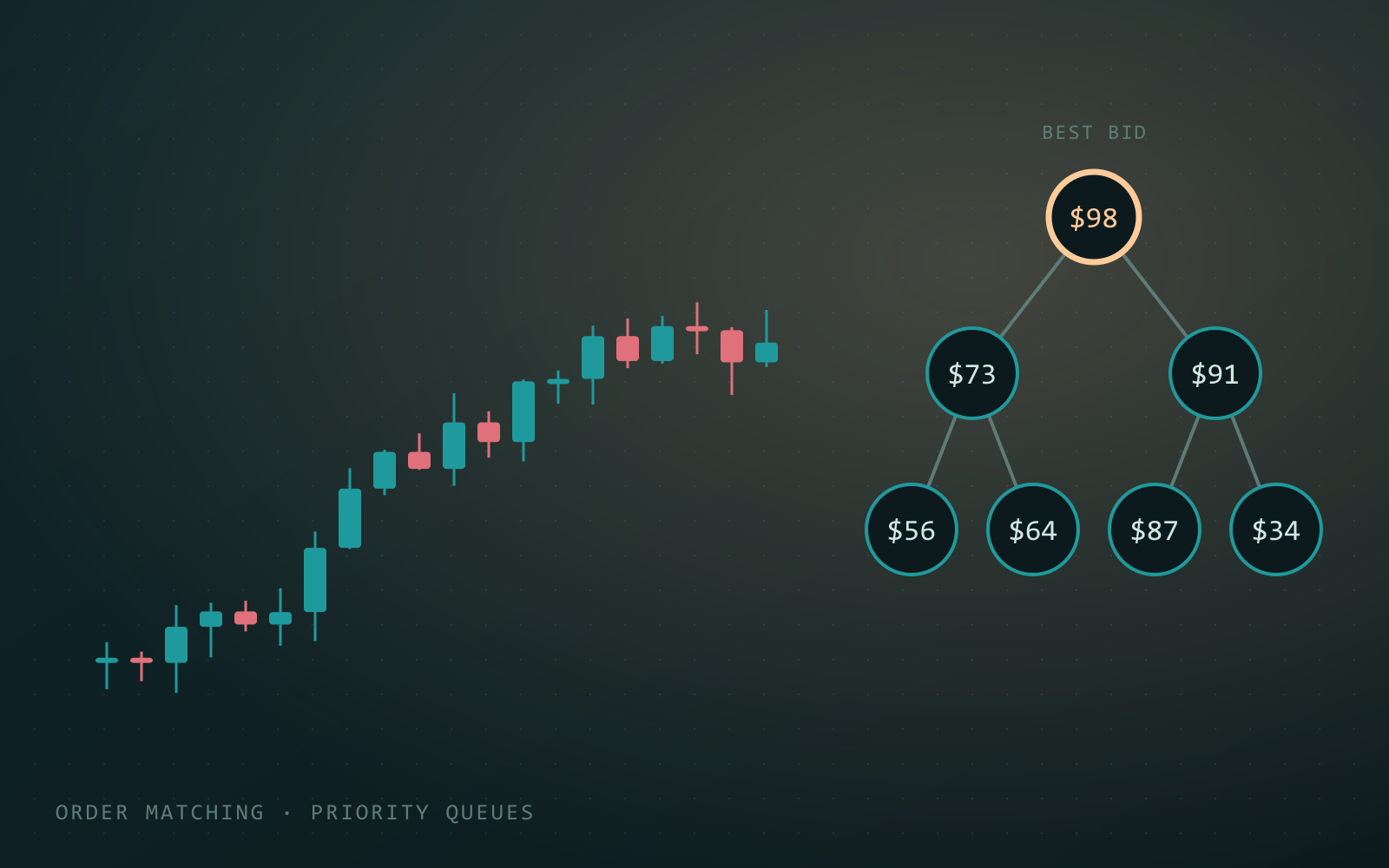
Two halves that meet in the middle. A market simulator streams timestamped buy and sell orders from many traders and matches them at the best available price. Underneath it sits a priority queue library written from scratch, ranging from an unordered array to a binary heap and a pairing heap.
- Stack
- C++Priority QueuesHeapsTemplates
- Highlights
- Order matching by best price, oldest order first on ties
- Running median match price per stock
- Binary heap and pairing heap alongside sorted and unordered queues
The problem
An exchange receives orders out of the blue: trader 2 wants to sell 42 shares of stock 0 at $56, trader 1 wants to buy 19 at $73. Each new order has to be matched instantly against the best waiting order on the other side, so "best waiting order" has to be cheap to find, over and over.
The plan
Matching. Each stock keeps a queue of buy orders (highest price first) and a queue of sell orders (lowest price first). When the best buy meets or beats the best sell, a trade happens at the waiting order's price. Partial fills leave the remainder in the queue.
Reporting. Optional modes print every trade as it happens, a running median match price for each stock, an end-of-day summary per trader, and a "time traveler" report: the best buy-then-sell a trader could have made with perfect hindsight.
The queues themselves. The same interface is implemented five ways: an unordered array, a faster unordered variant, a sorted array, a binary heap, and a pairing heap. They're templated on element type and comparator, so the simulator can swap between them and the trade-offs show up in real timings.
Where it stands
In progress.