EV Charging Control Module
The charger's safety logic was designed as a finite state machine in Simulink, ported to Python so every input combination could be tested, and paired with a desktop GUI for entering parameters and running the module.
- Stack
- PythonSimulinkPySide6Finite State Machines
- Highlights
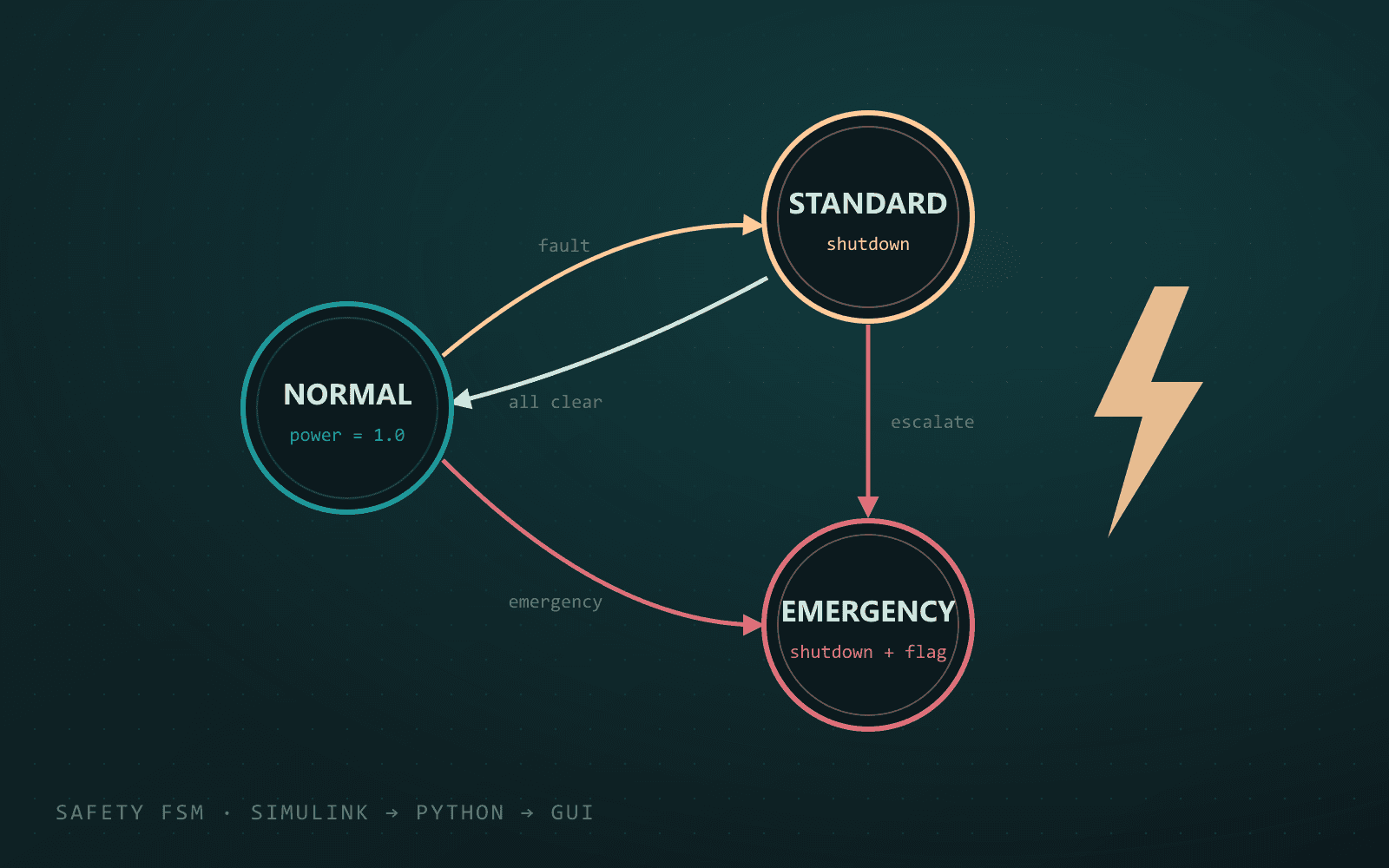
- Three-state safety FSM with prioritised emergency and standard shutdown
- Python port driven by a truth table of input scenarios
- Qt GUI with parameter validation, run timer, logging and file upload
The problem
A charging module has to fail safe. When conditions go wrong, the charger must drop power, and it must always prefer the more cautious response when more than one fault is present.
Approach
State machine in Simulink. The safety logic has three states: normal operation, standard shutdown, and emergency operation. Emergency conditions take priority over standard ones, a standard shutdown can escalate to an emergency, and only an all-clear returns the charger to normal.
Ported to Python to test it. The same machine was rebuilt in Python and run against a truth table of input scenarios. That gave fast, readable checks of every transition outside Simulink, and made the logic easy to drop into a Python pipeline.
A GUI for the bench. A PySide6 desktop app groups the module's parameters, validates them before a run, tracks status, errors and runtime, and saves both parameters and logs to file.