75% ISO Hall-Effect Keyboard
A 75% ISO Hall-effect keyboard built around an STM32 microcontroller. Every key is measured as an analog value rather than a switch closure, which means adjustable actuation depth per key. Designed with an emphasis on power integrity, signal integrity, and manufacturability.
- Stack
- STM32AltiumPCB DesignEmbedded CAnalog ElectronicsCAD
- Highlights
- Per-key analog measurement for adjustable actuation depth
- Addressable RGB, rotary encoder, and OLED support
- Power and signal integrity treated as first-order design constraints
- Custom-designed case
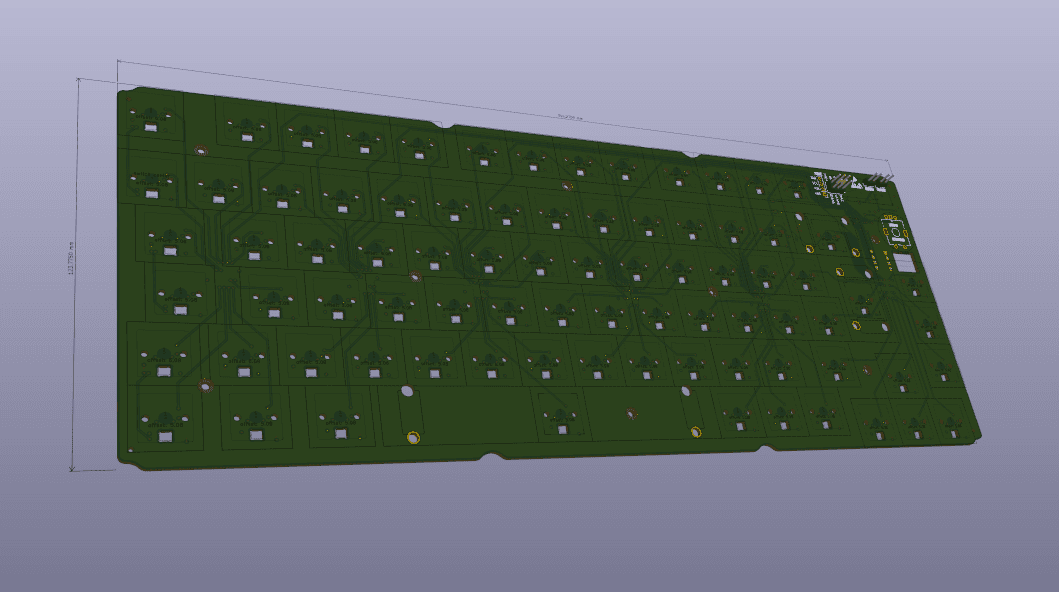
The problem
A mechanical switch is a binary sensor: pressed or not. A Hall-effect switch reports a magnetic field strength that varies continuously with travel — which means the keyboard knows how far down each key is, and actuation depth becomes a per-key setting rather than a property of the switch you soldered in.
Getting that requires reading an analog value from every key, cleanly, fast enough that no one perceives latency.
Approach
Analog integrity first. The signal being measured is a small voltage varying with magnet distance, on a board that also carries addressable RGB switching current at every key. Getting a clean reading is a layout problem before it is a firmware problem — ground pours, return paths, and keeping the analog sense lines away from everything noisy.
Power design as a first-order concern. Per-key RGB plus an OLED plus an STM32 doing continuous ADC sampling adds up. Designing the power tree properly at the schematic stage is much cheaper than discovering brownouts on assembled hardware.
Manufacturability as a constraint, not an afterthought. Component choices, footprint decisions, and assembly tolerances were made against what can actually be fabricated and hand-assembled — a board that only works in CAD is not a board.
Case designed alongside the PCB. Mounting points, port cutouts, and the plate all came from the same model, so board revisions and case revisions stayed in step.
What I got out of it
A working keyboard, and a much better feel for the parts of embedded work that have nothing to do with code. Firmware bugs you can iterate on in seconds; a board respin costs weeks. That asymmetry changes how carefully you read a datasheet.