LC-2K Assembler
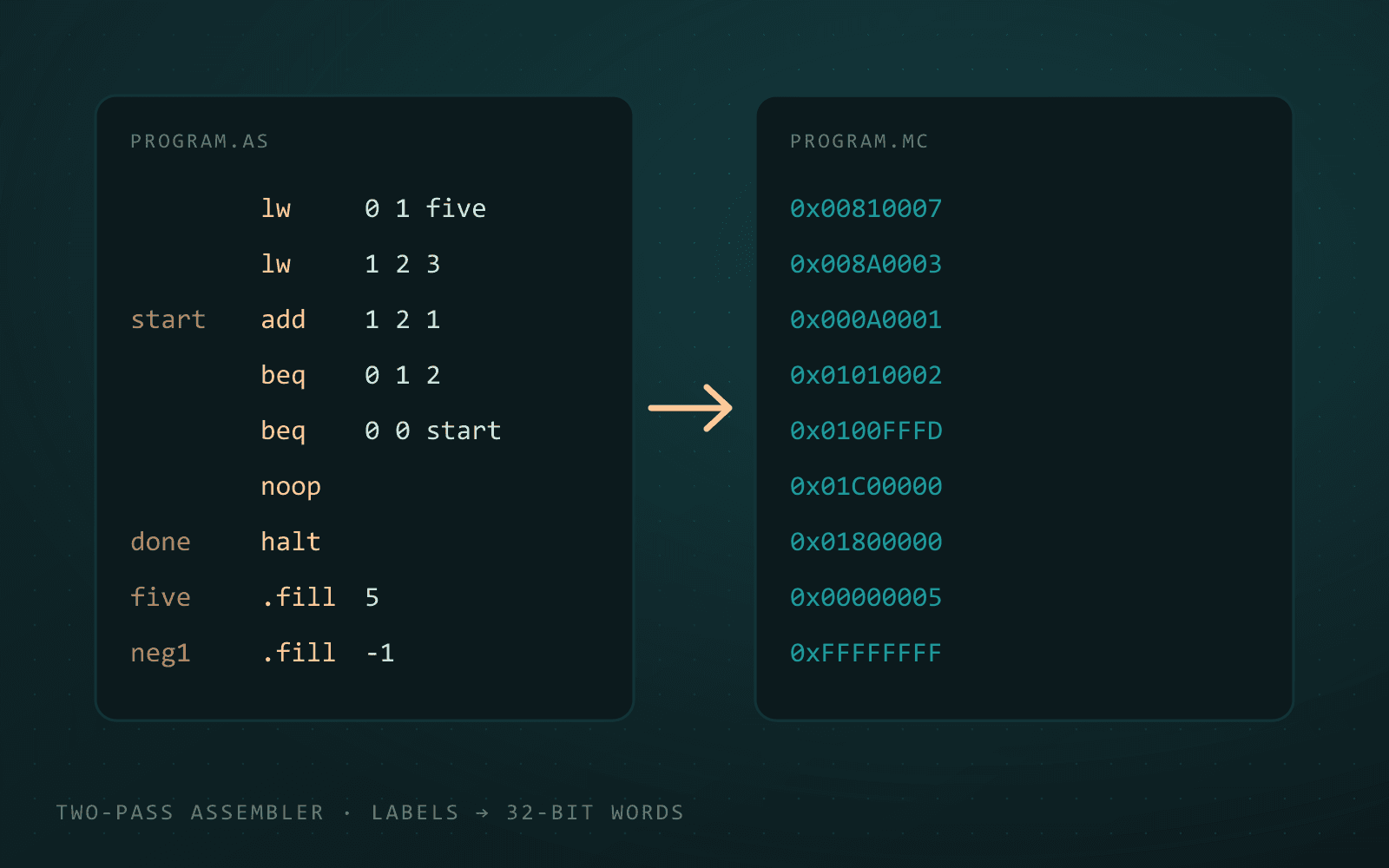
An assembler for LC-2K, a compact 8-instruction ISA. It resolves labels in a first pass, encodes each instruction into a 32-bit word in the second, and rejects malformed programs with specific errors.
- Stack
- CAssemblyComputer ArchitectureMake
- Highlights
- Two-pass design with a label table
- Bit-level encoding of R-, I- and O-type instructions
- Validation for bad labels, duplicates, unknown opcodes and offset overflow
The problem
Assembly is written with labels and mnemonics; the machine only understands 32-bit words. An assembler has to bridge that exactly, and fail loudly on anything ambiguous.
Approach
Pass one: labels. The first pass reads every line and records each label's address, so a branch can refer to a label defined further down the file.
Pass two: encoding. Each instruction is packed into a 32-bit word: opcode,
register fields, and a 16-bit signed offset for I-type instructions, with
.fill directives resolved to numbers or label addresses.
Errors as a feature. Labels are checked for length, first character and
duplicates. Opcodes, register numbers and offsets that don't fit in 16 bits
are all rejected. Each case has its own test program, from duplicate.as to
undef_label.as.