Low-Level Modulator
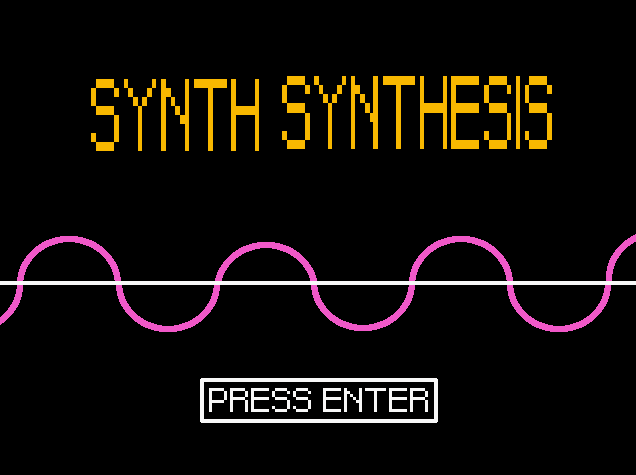
A microprocessor-based synthesizer built on an Altera DE2-115 FPGA. A custom 18-instruction processor in Verilog runs 40 assembly modules that synthesize audio and animate a matching waveform — so an eight-year-old can see and hear what amplitude, frequency, and phase actually do.
- Stack
- VerilogAssemblyFPGADigital LogicDSP
- Impact
18
Instructions
40
Assembly modules
32-bit
Audio depth
30 FPS
Frame rate
- Highlights
- Custom 18-instruction processor in Verilog on a DE2-115 FPGA
- Integer-math DSP pipeline — no floating point
- 3 wavetables, 5 modulations, 32-bit audio at 30 FPS
The problem
Modulation is one of those concepts that is obvious once you have seen it and impenetrable before. Turning a knob changes a number; the number changes a waveform; the waveform changes what you hear. Explained in words it is a definition. Shown as a live waveform moving in time with the sound it produces, it takes about four seconds.
The constraint that made it interesting: build it on an FPGA, on a processor we designed ourselves.
Approach
A processor sized to the problem. 18 instructions — exactly what the synthesizer needs and nothing more. Every instruction earns its place in the decode logic, and the whole ISA fits in your head while writing assembly against it.
Integer math, because there is no FPU. The DSP pipeline synthesizes 32-bit audio from three wavetables with five modulations using fixed-point integer arithmetic throughout. Floating point was not an option, which turned out to be a good constraint — it forced explicit reasoning about precision at every stage rather than trusting a float to absorb it.
Audio and video locked together. The waveform animates at 30 FPS in sync with the audio it represents. If the display drifts from the sound, the whole teaching purpose collapses — a child would be watching one thing and hearing another.
Where it landed
40 assembly modules running on our own silicon design, driving a synthesizer that works as an interactive toy for ages 8+.
Writing the assembly for a processor you designed yourself is a strange feedback loop. Twice I added an instruction because the assembly was painful without it — a luxury that does not exist on hardware you did not build.