Log Manager
Log files are huge, and almost every line in them is noise. logman reads a master log once, builds the indexes it needs up front, and then drops into an interactive prompt where searches, edits and printouts all run without rescanning the file.
- Stack
- C++STLHash MapsBinary SearchInverted Index
- Highlights
- Timestamp range searches in O(log n) by binary search over a pre-sorted log
- Case-insensitive category lookups through a hash map built at load time
- Multi-word keyword search over an inverted index with sorted-list intersection
- Excerpt list stores indices into the log, never copies of entries
The problem
Every log line is a timestamp, a category and a message:
10:09:03:45:50|TCP|Packet 0x4235124 sent
09:15:12:00:00|Clock|Noon 09/15
A developer chasing a bug wants to say "everything from TCP between these two
times", or "every entry mentioning both load and breakdown", pull the hits
into a short list of notes, reorder or trim that list, and print it. On a log
with hundreds of thousands of lines, scanning the whole file for every query is
too slow, and copying entries around for every edit wastes memory.
The plan
Do the expensive work once. On load, the log is sorted a single time by timestamp, then category (case-insensitive), then original entry ID. Every later search and printout relies on that order, so results come out already sorted and never need sorting again.
One index per kind of search.
- Timestamps: because the log is sorted by time, a range or exact-time search
is just a
lower_bound/upper_boundpair. The result is a start and end index, with nothing copied. - Categories: a hash map from lowercased category to the sorted positions of its entries, so a category search is one lookup.
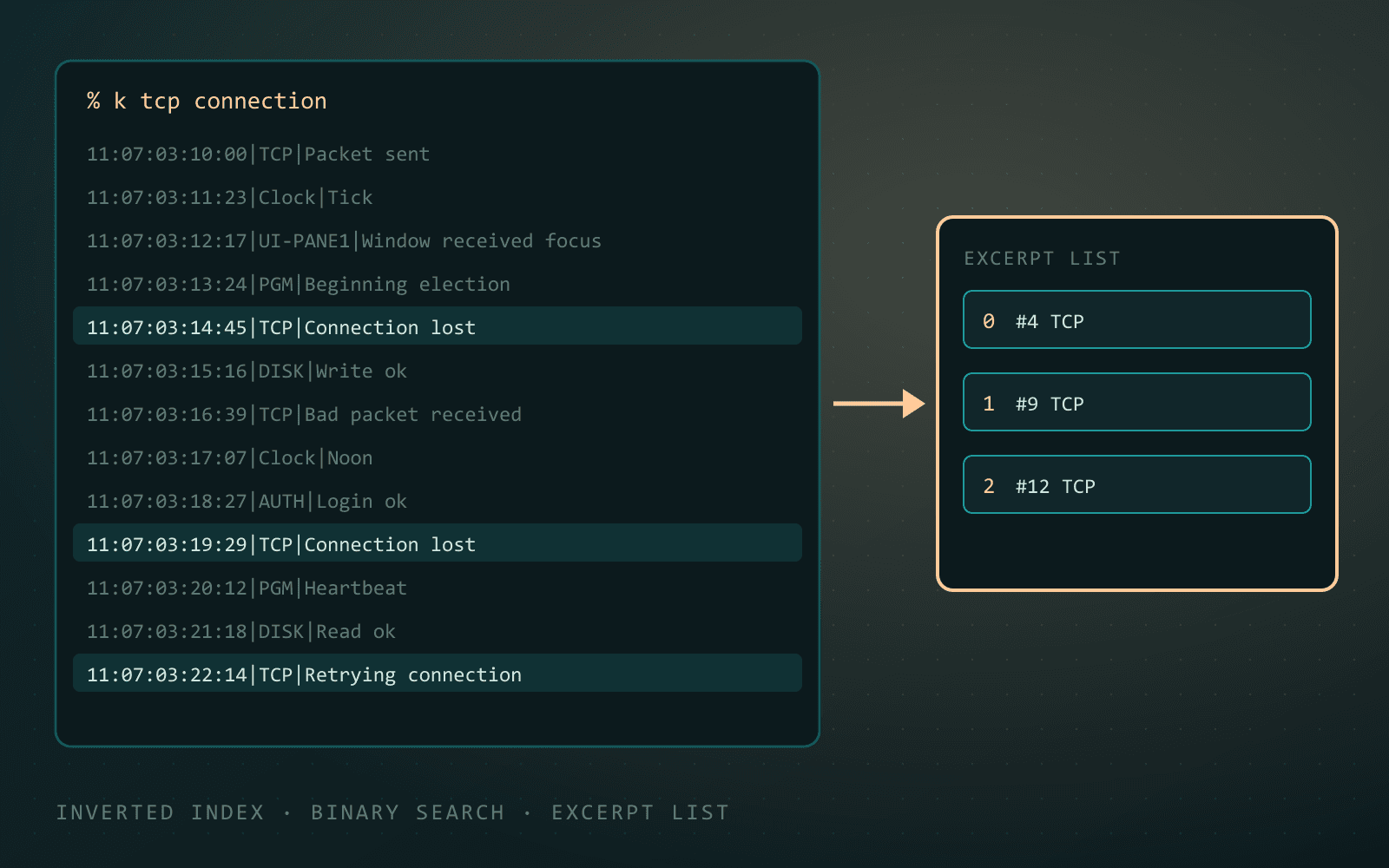
- Keywords: an inverted index from each word to the entries that contain it. Category and message are split on non-alphanumeric characters, lowercased, and de-duplicated per entry before indexing. A multi-word query starts from the first word's list and intersects it with each of the others, stopping as soon as a word has no matches.
An excerpt list of indices. The user's working list is a deque of integers pointing into the sorted log, so appending a whole search result, moving an entry to the front or back, deleting one, or sorting the list moves small integers rather than strings. Because positions in the sorted log already encode timestamp/category/ID order, sorting the excerpt list is a plain integer sort. A separate table maps each original entry ID to its sorted position so entries can still be appended by the ID the user sees.
A forgiving prompt. Commands are single letters read from an interactive
% prompt or a redirected file. Bad input (an unknown command, a malformed
timestamp, an out-of-range position, printing results before any search) gets
a one-line error on stderr and a fresh prompt rather than a crash.
Where it stands
Finished. It handles the full command set (four kinds of search, seven excerpt-list edits, and the two print commands) and ships with a set of small hand-written log and command files built to catch edge cases like duplicate lines, case-only differences and empty searches.