Overround
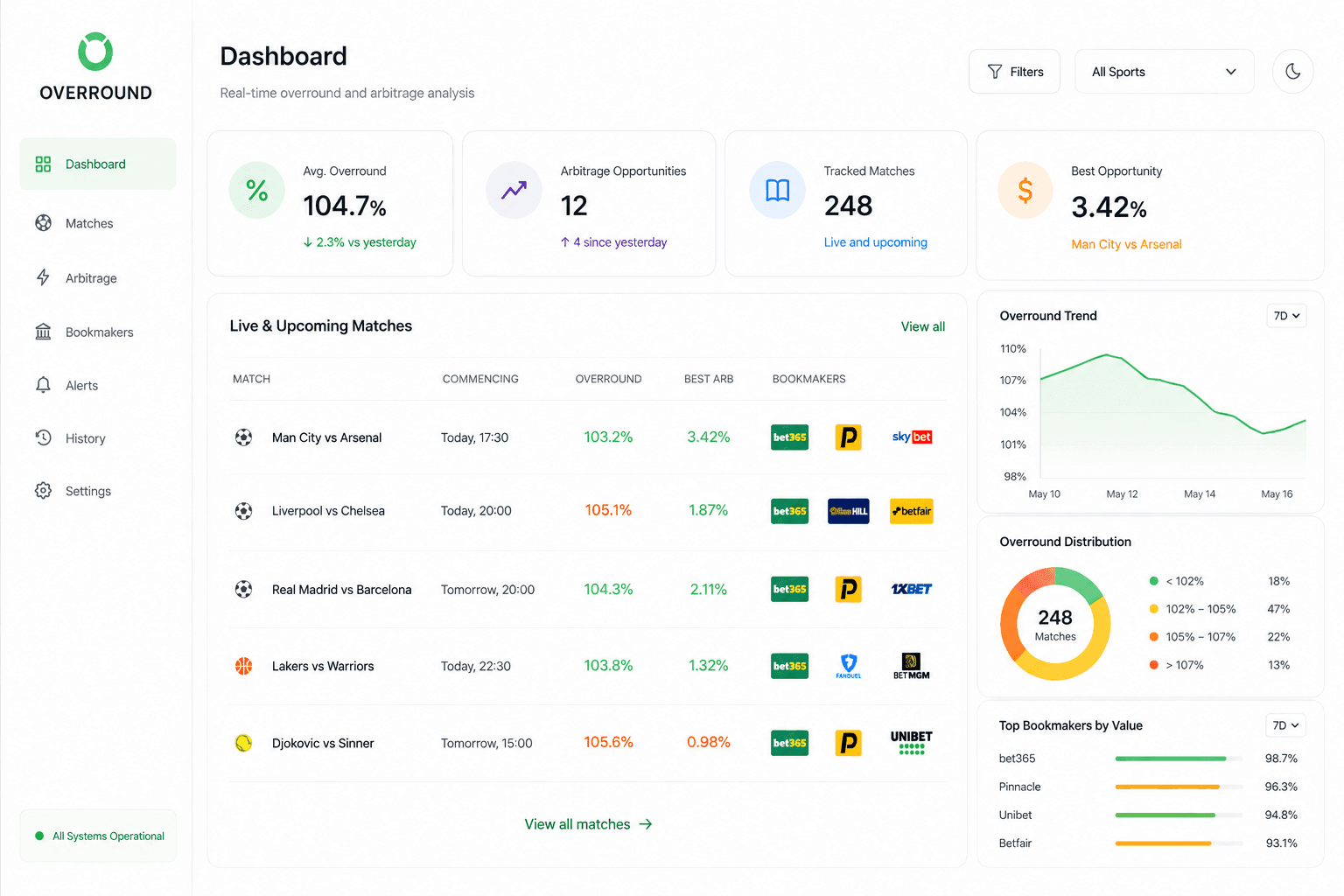
A football prediction system in two halves: a transformer that learns club representations across five domestic leagues, and a C++ Monte Carlo engine that simulates the 36-team Champions League phase at 5,000+ simulations per second.
- Stack
- C++PythonPyTorchReactD3.jsFastAPIPostgreSQL
- Impact
18,000+
Matches trained on
5
Leagues
5,000/s
Simulations
36 teams
League phase
- Highlights
- Learned club embeddings solve cross-league strength calibration
- Outperforms Dixon-Coles and Elo baselines
- Multithreaded C++ Monte Carlo engine simulates the full league phase
The problem
Predicting the Champions League is harder than predicting a domestic league, and the reason is a measurement problem rather than a modelling one. Clubs arrive from five different leagues having only ever played teams inside their own. A 20-goal season in one league is not the same evidence as a 20-goal season in another, and there are very few cross-league fixtures to calibrate against.
Classical approaches — Dixon-Coles, Elo — handle within-league ranking well and cross-league calibration poorly.
Approach
Learned club embeddings. Rather than hand-specifying league strength coefficients, the model learns a representation per club from 18,000+ matches across five leagues. Cross-league fixtures, sparse as they are, tie the embedding spaces together, and the transformer picks up the calibration implicitly instead of it being an assumption baked in beforehand.
Simulation separate from prediction. The model produces match-level outcome distributions. Turning those into "what are this club's odds of reaching the quarter-finals" requires simulating the tournament many thousands of times — a fundamentally different workload, so it lives in a different language. The Monte Carlo engine is multithreaded C++ running the full 36-team league phase at 5,000+ simulations per second.
Baselines that are real. Dixon-Coles and Elo implementations run against the same held-out fixtures. A model that cannot beat Elo is not a model worth shipping, and having the comparison in the loop keeps that honest.
Where it stands
The transformer and simulation engine both run and the model outperforms both baselines. The React and D3 front end for exploring probability distributions is in progress.
Target is to ship before Matchday 2 of the league phase. Predictions are only worth anything against fixtures that have not been played yet, so the deadline is set by the calendar rather than by when the front end feels finished.