LC-2K Assembler & Linker
Real programs are split across files and call code they didn't write. This toolchain makes that work for LC-2K: the assembler emits object files with symbol and relocation tables instead of finished machine code, and the linker stitches them together, resolves every cross-file reference, and places the stack after everything else.
- Stack
- CAssemblyComputer ArchitectureLinkersMake
- Highlights
- Object files with a header, text, data, symbol table and relocation table
- Local vs. global labels, with undefined globals left for the linker to resolve
- Links 1–6 object files, relocating every local and global reference
- Catches duplicate and undefined globals, and programs that define Stack
- A recursive combination function in assembly that keeps its state on the stack
The problem
My earlier LC-2K assembler turned one file straight into machine code, which only works if everything a program needs lives in that file. As soon as one file calls a function defined in another, the assembler can't know where that function will end up. Something has to record what is missing, and something else has to fill it in once every file is known.
The plan
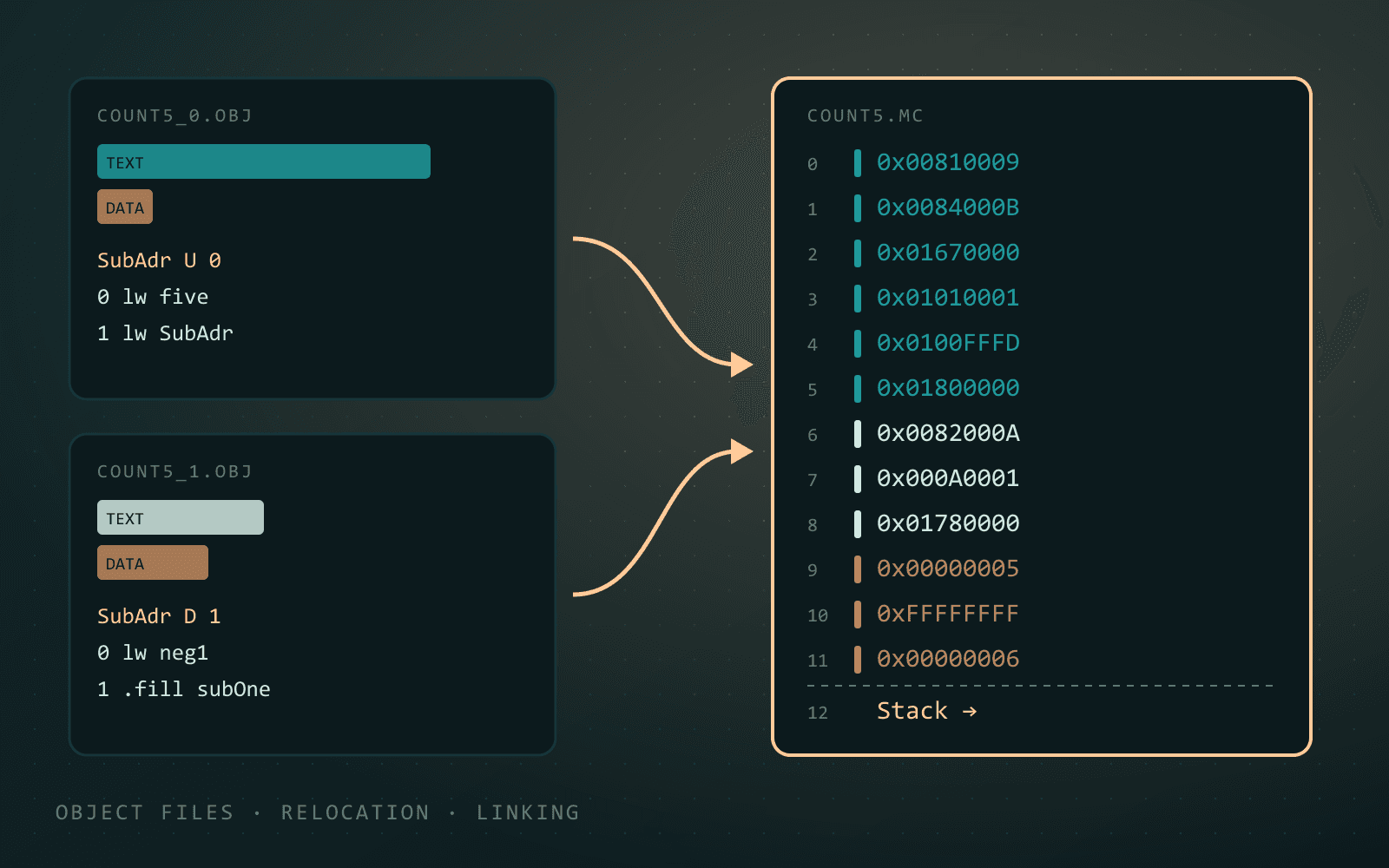
Assembler: write down what you don't know. Instead of finished machine code, the assembler emits an object file in five parts:
6 1 1 2          header: text, data, symbol, relocation sizes
0x00810006       text
...
0x00000005       data
SubAdr U 0       symbol table
0 lw five        relocation table
1 lw SubAdr
Labels starting with a lowercase letter are local to their file; capitalised
labels are global. A global used but not defined here is assembled as address
0 and listed as Undefined in the symbol table. Every lw, sw or
.fill that uses a label, local or global, gets a relocation entry, because
its address will move once files are combined. beq is skipped, since it's
PC-relative and can only target its own file.
The assembler still rejects bad input: undefined local labels, a beq to an
undefined label, duplicate labels, offsets that don't fit in 16 bits,
unknown opcodes and invalid registers.
Linker: lay out, then patch. The linker reads up to six object files and lays out the executable as every file's text in argument order, then every file's data. The first file passed is where execution starts. For each file it records where its text and data now begin, which is all it needs to fix references:
- Local labels have no symbol table entry, so the linker reads the old address back out of the instruction, works out whether it pointed into that file's text or data, and shifts it by how far that section moved.
- Global labels are looked up across every file's symbol table and replaced with their final address.
- Stack is reserved: it resolves to the first word past all text and data, so the stack can grow upward without overwriting anything.
Linking fails if a global is defined twice, is never defined, or if any file
tries to define Stack itself.
Recursion in assembly. To exercise the whole toolchain, I wrote a
recursive combination(n, r) in LC-2K that calls itself twice per level.
Each call pushes its return address and arguments onto the stack, so no
register carries state between calls, and the result comes back in a single
register. The output is assembled, linked and run on my LC-2K simulator.
What I tested
Every assembler error has its own test program, and multi-file test groups check linking: locals with the same name in different files, globals used before they're defined, data that points into text, and each of the linker's error cases.