Pipelined Processor Simulator
A single-cycle simulator tells you what a program computes. A pipelined one has to get when right too: five instructions in flight at once, each in a different stage, all reading and writing shared state on the same clock edge. This simulator models that cycle by cycle and prints every pipeline register on every cycle.
- Stack
- CComputer ArchitecturePipeliningAssemblyMake
- Highlights
- Five stages plus a WB/END register, modelled cycle by cycle
- Two-state clocking so every stage updates on the same edge
- Separate instruction and data memory
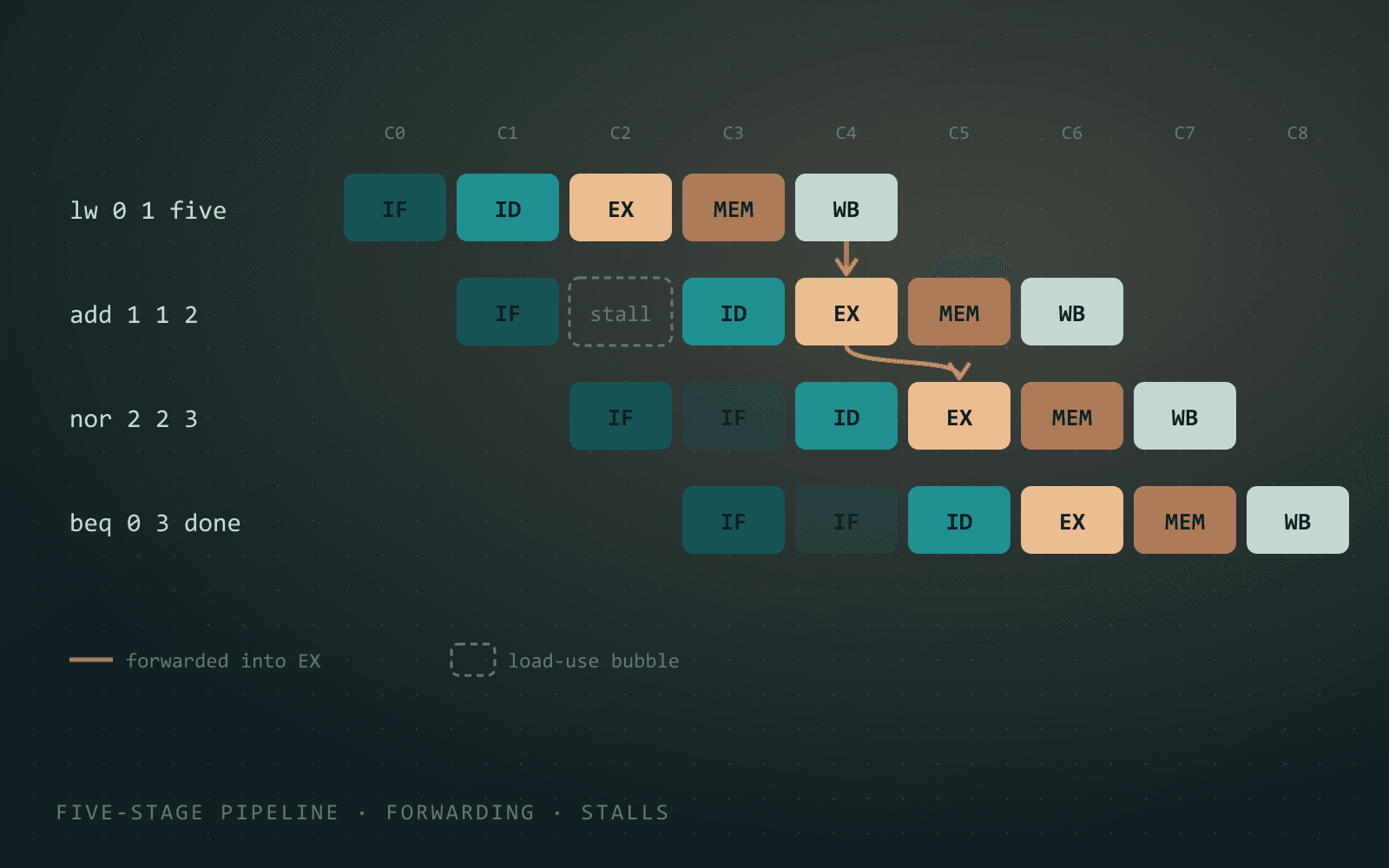
- Forwarding into EX, a one-cycle stall for load-use hazards, and squashing on mispredicted branches
The problem
In a pipeline, an add can start before the lw it depends on has finished
loading. A branch isn't resolved until three more instructions have already
been fetched behind it. Getting the program's answer right isn't enough: the
contents of every pipeline register have to match real hardware on every
cycle.
The plan
Clock it like hardware. Each loop iteration is one cycle. Every stage
reads only from state (the outputs of the clocked registers) and writes only
to newState (their inputs), and state = newState is the rising clock edge.
That keeps the five stages logically simultaneous even though C runs them one
after another.
Five stages, six registers. IF fetches from instruction memory and passes PC+1 along. ID is the only stage that reads the register file. EX runs the ALU. MEM loads and stores against a separate data memory. WB writes back. The register file has no internal forwarding, so a WB/END register holds the last written value one more cycle for later forwarding.
Hazards.
- Forwarding: EX takes its operands from the newest source available, checking EX/MEM, then MEM/WB, then WB/END, before falling back to the value read in ID.
- Load-use stall: when a
lwis followed by an instruction that reads its destination register (other thanr0), ID holds that instruction for one cycle and sends anoopbubble down instead. - Branches: predict not-taken and keep fetching. A
beqresolves in MEM, and if it's taken, the three instructions fetched behind it are replaced withnoops.
Halting. The machine stops when halt reaches MEM/WB rather than when
it's fetched, because a branch ahead of it might still squash it.
Where it stands
The full pipeline runs hazard-free programs correctly: all five stages, the WB/END register, and split memories. Forwarding, the load-use stall and branch squashing are being built next, along with a test suite aimed at each of those paths individually.