Limit Order Book & Matching Engine
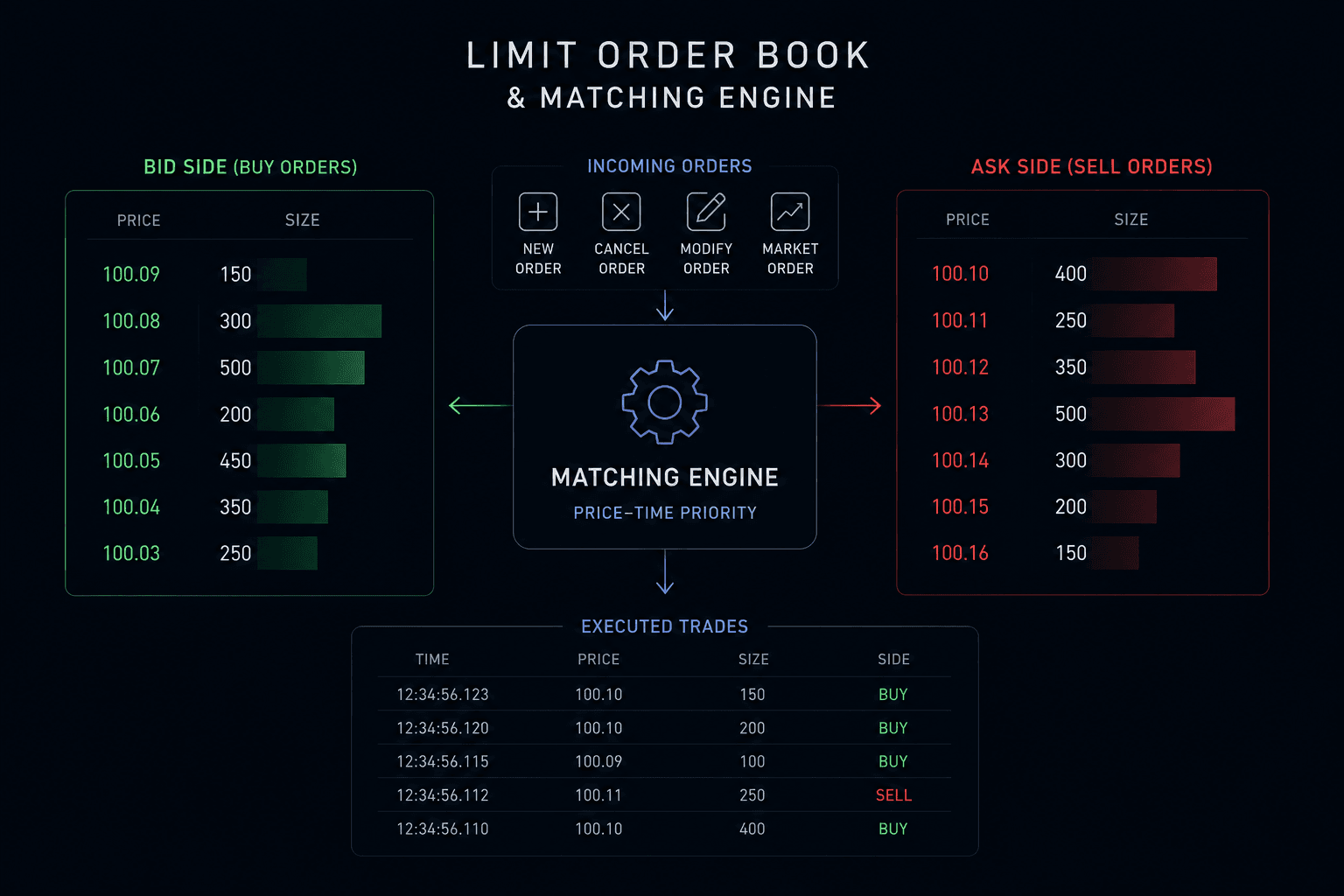
An exchange matching engine built from scratch in C++. It maintains a limit order book with strict price–time priority and handles market orders, cancellations, modifications, and partial fills — every core operation completing in under a millisecond.
- Stack
- C++LinuxData StructuresSystems ProgrammingGit
- Impact
100K+/s
Throughput
<1ms
Execution
40–60%
Latency cut
1M+
Events validated
- Highlights
- Price–time priority across market, limit, cancel, modify, and partial fills
- Cache-efficient layouts and custom allocators cut latency 40–60%
- Validated against 1M+ simulated order events under live-market conditions
The problem
A matching engine is a deceptively simple specification: keep resting orders sorted by price, break ties by arrival time, and cross incoming orders against the best available price. The difficulty is not the logic — it is doing it fast enough, consistently enough, that the tail latency stays flat while the book is thousands of levels deep and orders arrive in bursts.
I wanted to build the whole thing rather than read about it, because the interesting decisions in this problem are all decisions about memory.
Approach
Price–time priority, done properly. Every order carries an arrival sequence. Orders at the same price level match strictly in the order they arrived, which is what real exchanges guarantee and what makes the engine's behaviour reproducible under replay.
Memory layout as the primary optimisation. The naive implementation — a map of price levels to lists of orders — spends most of its time chasing pointers. Restructuring around cache-efficient containers, tight struct packing, and custom allocators that keep hot order data contiguous brought latency down 40–60% without changing a line of matching logic.
Validation by replay. Correctness in a matching engine is not something unit tests fully cover; the failure modes come from sequences, not single operations. I drive the engine with 1M+ simulated order events reproducing live-market conditions and assert book invariants after every one.
Where it stands
The core engine handles all order types at sub-millisecond execution and sustains 10K–100K+ orders/sec depending on book depth and order mix.
Next: a full order-entry protocol layer, and benchmarking against a lock-free multi-threaded variant to see whether the contention cost is worth the parallelism at realistic message rates.